REVIEW · ANTWERP
Evening Walking Tour: The Dark Side of Antwerp
Book on Viator →Operated by Legends Walking Tours of Antwerp · Bookable on Viator
Antwerp changes after sunset. This guided evening walk leans into the city’s darker legends and side-stories, using a simple idea: you don’t need a map when the guide knows the turns. You’ll move through famous squares and landmark streets while hearing how the city’s money, crime-adjacent rumors, and old institutions shaped everyday life.
I really like the no-map navigating. The route is handled for you, and that makes the whole experience feel smoother at night, especially when streets are busier than they should be. I also like the ending viewpoint at MAS, where the night skyline and the harbor view give the tour a satisfying finish.
One thing to consider: the tour’s “dark side” is mostly stories, legends, and historical context, not a horror movie. If you’d rather skip the Red Light District part, you can request that ahead and keep the night focused on the rest of Antwerp.
In This Review
- Key things you’ll notice on this tour
- Why Antwerp’s dark-side stories work best at night
- Meeting at Grote Markt: letting the guide handle the route
- Grote Markt at the start: guild houses, City Hall, and Brabo’s legend
- Cathedral and belfry: why Antwerp’s skyline is more than a view
- The diamond trade stop: Antwerp’s Golden Age, bright and dark
- Steen Castle: stepping into a prison-shaped past
- Museum Vleeshuisi: from butchering to sound, music, and dance
- St. Paul’s Church: Antwerp’s masters gathered under one roof
- Red Light District on the route: what to expect and how to skip it
- FelixArchief: the port warehouse turned into a firebreak interior
- MAS rooftop finish: harbor views, building context, and next-step ideas
- Price and value: paying per group, not per person
- How to get the most from your guide in 90 minutes
- Who should book this Antwerp dark-side walk
- Should you book this Evening Walking Tour: The Dark Side of Antwerp?
- FAQ
- Where do I meet for the tour?
- What time does the tour start?
- How long is the walking tour?
- Is the tour offered in English?
- How big are the groups?
- Does the route include Antwerp’s Red Light District?
- Where does the tour end?
- What happens if the weather is bad or I need to cancel?
Key things you’ll notice on this tour
- You walk with a real guide the whole time, so you’re not trying to follow directions after dark.
- Steen Castle gets the spotlight, including what it was like when the oldest building in Antwerp functioned as a prison.
- Diamonds in Antwerp are framed as both the shiny and the complicated side of the city’s Golden Age wealth.
- Red Light District streets are optional, and the area is described as safe to walk through at night.
- FelixArchief (Felix Pakhuis) shows how a port-storage building was shaped internally as a firebreak.
- The MAS rooftop finish brings the harbor view, plus recommendations for what to do next (with a Monday exception).
Why Antwerp’s dark-side stories work best at night
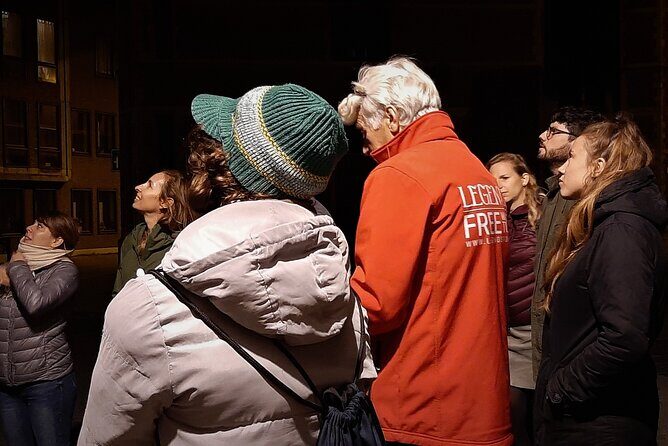
This is an evening tour at 8:00 pm, and that timing matters. In the daytime, Antwerp can feel like a postcard. After sunset, the same streets and façades start acting like stage sets, and the legends make more sense when the city is quieter and the mood shifts.
You’re also dealing with a manageable group size. The tour caps at 35 people, which keeps the walk from feeling like a school field trip, and it helps you actually hear the guide instead of competing with everyone’s photos. Plus, the pacing is built for stories as you go—short stops, then you’re moving again.
What makes this experience different is its angle. It doesn’t just count monuments. It connects Antwerp’s medieval institutions, the diamond trade’s bright reputation, and the grayer urban realities into one continuous night walk. If you like Antwerp for more than the obvious highlights, this fits.
You can also read our reviews of more walking tours in Antwerp
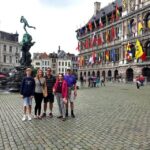

Meeting at Grote Markt: letting the guide handle the route
You start at Grote Markt 9, near the center of Antwerp’s historic core. The meeting point is practical: it’s in the thick of the action, and it’s easy to spot once you know the address. You’ll get a mobile ticket, so you’re not juggling paper while you’re trying to keep up.
Another plus: the tour is offered in English, and it’s designed for most people to join. Service animals are allowed too, so you don’t have to stress about that ahead of time. And since it’s “near public transportation,” you can plan your evening without building your schedule around taxis.
The real win here is that you’re not map-reading. The guide takes care of navigating, so you’re free to look up at buildings, listen closely, and follow the stories rather than losing the group at every corner. At night, that difference is huge.
Grote Markt at the start: guild houses, City Hall, and Brabo’s legend
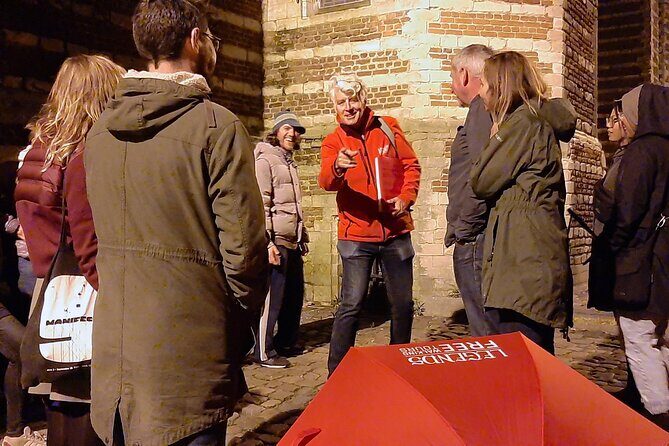
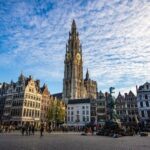
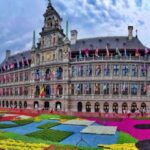
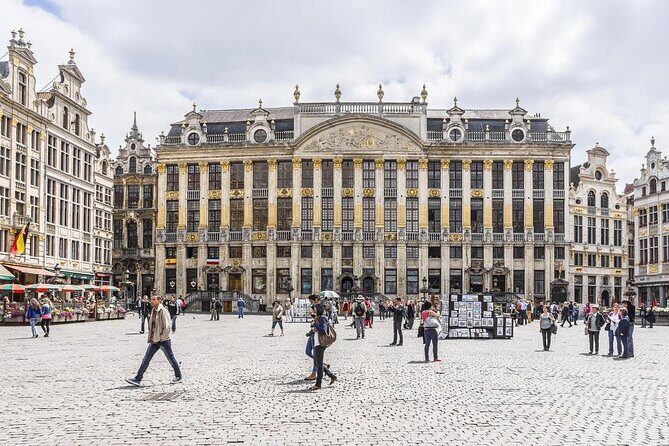
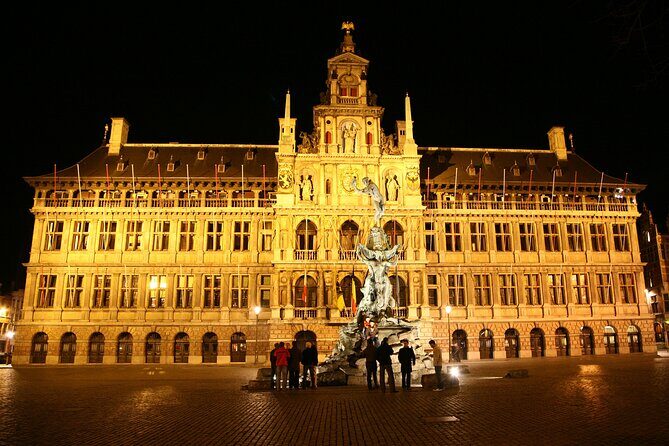
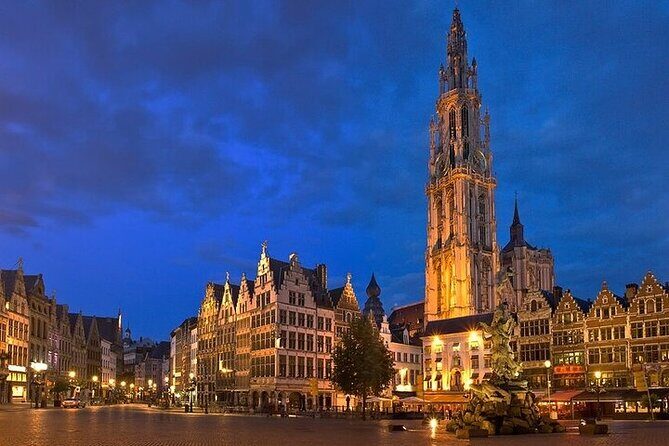
The tour begins at Grote Markt, Antwerp’s central square. This is the part where classic Antwerp postcards usually start, but you’re not just seeing pretty façades—you’re hearing the kinds of legends that hide in plain sight.
You’ll see the medieval guild houses, the City Hall, and the Brabo Fountain in the middle. Even if you’ve walked through Grote Markt before, hearing the square framed through local stories changes how you notice details. Squares like this are built to impress, and guides often explain how power was displayed—who paid for what, who controlled trade, and why the architecture is arranged the way it is.
It’s also a good warm-up stop. It gets you oriented, your group finds its rhythm, and you learn the guide’s storytelling style early on. That makes the later turns feel less random.
Cathedral and belfry: why Antwerp’s skyline is more than a view
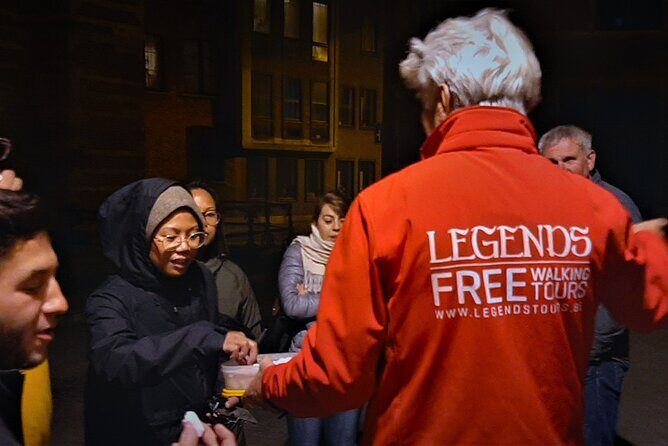
After Grote Markt, the tour shifts to the cathedral and its belfry tower—the kind of skyline landmark you can’t miss once you’re in the city center. The guide explains the history behind them, which adds meaning to what would otherwise be a quick photo stop.
This is one of those stops where the value is less about what you can count and more about why it mattered. A belfry isn’t just a tall structure; it’s tied to civic pride, authority, and how cities announced themselves. When the guide connects the architecture to how Antwerp saw itself, the tower starts feeling like a character rather than background scenery.
Expect the stop to be short, and don’t plan to linger on your own during the walk. The tour keeps moving so the night story stays tight.
The diamond trade stop: Antwerp’s Golden Age, bright and dark
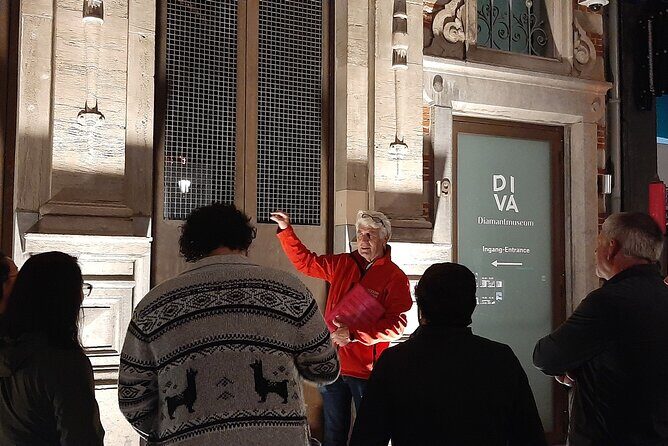
Then comes the diamond angle, because Antwerp has long been known as a world hub for diamonds. You’ll visit a diamond museum built to explain why Antwerp became the Diamond Capital during its Golden Age—and, importantly, how the trade had both a bright side and a darker side.
This works for two reasons. First, diamonds helped shape the city’s wealth and reputation. Second, any major wealth machine has an opposite pull: power imbalances, secrecy, and human consequences. You don’t need a business degree to get it, but you do need a guide to connect the dots between glitter and systems.
If you care about Antwerp’s economics—how it became rich, and what that richness cost—this is one of the stops most likely to stick in your head after the walk.

Steen Castle: stepping into a prison-shaped past
One of the most compelling stops is Steen Castle, described as the oldest building in Antwerp. It has served multiple functions over the centuries, but mostly it was used as a prison. Your guide shares details about medieval prison life, turning the stone walls from “old stuff” into something more specific and human.
Why this stop lands: castles and fortifications are easy to romanticize. But when a guide talks about prisoners, routines, and daily realities, you get a different kind of connection to the past. You’re not just looking at architecture; you’re picturing what happened inside it.
It’s also a good contrast point after the diamond trade story. Wealth and justice don’t live in separate worlds. In cities like Antwerp, the same systems that built fortunes could also protect the people in power.
Museum Vleeshuisi: from butchering to sound, music, and dance
Next up is Museum Vleeshuisi, formerly the Butcher’s Hall and the oldest guild house in the city. That alone is interesting because it shows how Antwerp’s economy evolved—how a place tied to food and trade transformed into a cultural setting.
Here, the museum’s focus is described as sound, music, and dance. Even without turning this into a full museum visit, the guide’s explanation helps you see the building as a working piece of city life. It’s a reminder that guild houses weren’t just decorative; they were infrastructure for commerce and community.
For you, this is a nice mid-tour pivot. After darker-themed stops, it adds a more human rhythm. You finish this section feeling like Antwerp wasn’t only conflict and control—it also made art and entertainment out of old spaces.
St. Paul’s Church: Antwerp’s masters gathered under one roof
You’ll also stop at St. Paul’s Church, which is singled out for a very specific reason: it keeps works by Rubens, Van Dyck, and Jordaens within its walls. The guide frames it as the only church in the world with works by these three Antwerp masters in one place.
This is the kind of fact that changes a stop from casual to memorable. You don’t have to be a hardcore art buff to appreciate the odds. Antwerp is famous for these artists, but a church that houses their work together feels like a concentrated version of the city’s creative identity.
This stop can be especially satisfying if your evening walk started with the city’s darker legends and you’re glad the tour still gives you culture that’s genuinely world-class.
Red Light District on the route: what to expect and how to skip it
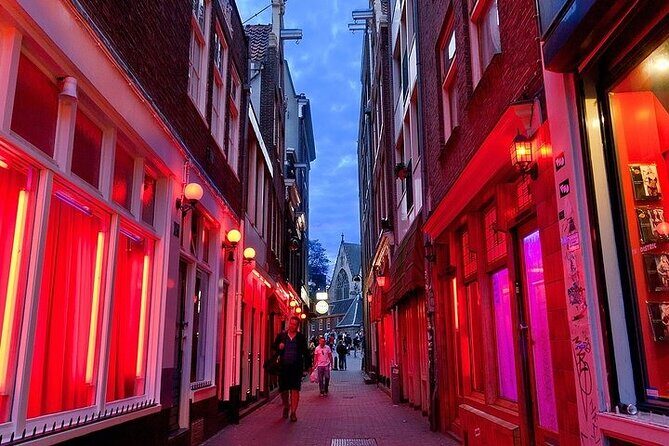
The tour then reaches Antwerp’s Red Light District. The key point here is the guide’s approach: it’s described as a safe area to walk around at night, even though you’ll hear some “spicy” secrets. And crucially for comfort, this part can be skipped on request.
How you should think about it: this isn’t a voyeuristic detour. It’s part of the tour’s attempt to explain how Antwerp works at street level—how a city’s reputation and its reality can coexist. If you’re uncomfortable with that setting, don’t tough it out. Request the skip and keep your energy for the quieter, more architectural stops.
If you do continue through it, do what you’d do anywhere at night: stick with your group, stay aware of your surroundings, and don’t get pulled off the route.
FelixArchief: the port warehouse turned into a firebreak interior
Next comes FelixArchief, housed in what used to be a port storage building called Felix Pakhuis. Your guide takes you through its distinctive interior “street,” created as a firebreak within the building.
This is a smart stop for anyone who likes how cities solve problems with design. Storage buildings at ports weren’t just places to stash goods—they were part of an entire logistics system. Fire safety, crowd flow, and material handling all shaped how structures were built.
In practice, this stop also works as a break from constant exterior walking. It gives your eyes a different kind of space—more enclosed, more architectural, and very easy to listen to inside.
MAS rooftop finish: harbor views, building context, and next-step ideas
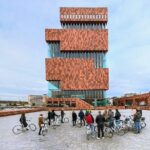
The walk ends at MAS (Museum aan de Stroom) on its panoramic rooftop, where you get a view over the Port of Antwerp. The guide also explains interesting facts about the building itself, and then offers recommendations for what to do next in Antwerp.
This ending is practical and satisfying. You get your payoff: the night skyline, the big water-and-industry view, and a mental reset before you head off to your own dinner plans.
There’s one catch: the rooftop finish is noted as an exception on Mondays. If your schedule is tight around that day, plan to check what will happen on arrival so you’re not expecting the exact same view.
Price and value: paying per group, not per person
The posted price is $3.62 per group (up to 6) for about 1 hour 30 minutes. That’s remarkably low on a per-group basis. In real terms, it means this tour can be a great deal if you’re traveling with friends or family and splitting costs.
The timing also matters. Some experiences run short, and you feel shortchanged. Here, the tour is described as around 90 minutes, but you may end up closer to 2 hours, which actually suits story-based walks. You get enough time for multiple stops and explanations without it dragging.
Also look at the structure: you get a professional guide and all fees and taxes are included. You don’t have to factor in museum entry costs along the route, since the stops are indicated as free with an admission ticket (or free at the stop level). For budgeting, that helps.
One more honest note: a very small price can confuse people who expect the classic free-walk tipping model. Make sure you understand what your booking includes. If you enjoy the guide’s work, tipping is a reasonable way to thank them—especially in city storytelling tours like this.
How to get the most from your guide in 90 minutes
This kind of tour depends on the guide’s delivery, and the names mentioned for the guides include Luc D, Beren, Tom, Arie, Been, and Marleen. That variety is a good sign: different personalities, same core route.
To get more out of the evening, I’d do two things:
- Ask questions that connect the story to what you see in front of you. A belfry, a castle wall, or a museum interior can all mean more when you ask why it was built that way.
- If you’re in a lighter mood, encourage the guide to share the more anecdotal parts. The tone on this walk is described as engaging, funny, and interactive, including trivia-style moments.
Bring comfy shoes. Evening walking tours are still walking tours, and Antwerp’s center has plenty of corners. And dress for night air. Even when the day is fine, evenings can cool down quickly.
Who should book this Antwerp dark-side walk
This works best if you want Antwerp beyond the usual checklist. If you like legends, architecture with a story behind it, and the idea that history includes the uncomfortable parts too, you’ll likely enjoy the way the tour threads it all together.
It’s also a good choice if you hate map-work after dark. The guide navigation keeps things simple, and the route is set up so you move efficiently between stops.
On the other hand, if you’re expecting a tour that focuses on real-life criminal activity or heavy “true crime” detail, this may feel more like historical storytelling and urban legend than gritty reality. The tour does name the Red Light District, but it’s handled as context, not shock value.
Should you book this Evening Walking Tour: The Dark Side of Antwerp?
I’d book it if you want a guided night walk that gives Antwerp’s center new meaning. The combination of Grote Markt landmarks, Steen Castle’s prison past, the diamond trade framing, and the finish at MAS rooftop is a strong evening package for the money.
I’d skip it only if “dark side” for you means something very specific and graphic, or if you’re likely to feel uncomfortable around the Red Light District setting. Since that segment can be skipped on request, you can often tailor the night to your comfort level—while still getting the best parts of the route.
If you’re curious about how Antwerp became wealthy, how power worked, and how the city’s buildings reflect that, this is one of the better ways to see it after sunset.
FAQ
Where do I meet for the tour?
You meet at Vereniging Zonder Winstoogmerk Antwerpen Studentenstad VZWG Grote Markt 9, 2000 Antwerpen.
What time does the tour start?
The start time is 8:00 pm.
How long is the walking tour?
It runs about 1 hour 30 minutes, and you may experience it closer to around 2 hours.
Is the tour offered in English?
Yes, it is offered in English.
How big are the groups?
The tour has a maximum of 35 travelers.
Does the route include Antwerp’s Red Light District?
Yes, it includes Antwerp’s Red Light District, but you can request that part to be skipped.
Where does the tour end?
It ends at MAS (Museum aan de Stroom) at Hanzestedenplaats 1, on the rooftop view (except on Mondays).
What happens if the weather is bad or I need to cancel?
You can cancel for a full refund if you cancel at least 24 hours before the experience start time. If poor weather causes cancellation, you’ll be offered a different date or a full refund.