REVIEW · GHENT
Evening Tour of the Dark Side of Gent
Book on Viator →Operated by Gent Free Walking Tour · Bookable on Viator
Ghent has a darker side, and it shows best at night. This Evening Tour of the Dark Side of Gent strings together medieval landmarks, rumors, and grim legends into a smooth, story-led walk that keeps your eyes busy even after the sun drops.
I especially liked the animated, funny guides—names like Kenny and Isabel pop up often for a reason—and the way the route hits classic viewpoints plus lesser-known corners for great night photos.
One thing to consider: the stories lean graphic and brutal. If you prefer light history only, or if you’re hunting for strictly spooky content, you might want to set expectations.
In This Review
- Key highlights you can plan around
- Why Ghent Looks Different After Dark
- Meeting at Hostel Uppelink: Start Point and Pacing
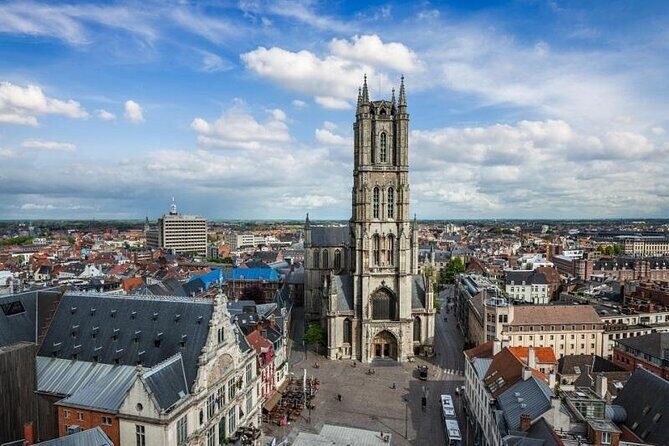
- Stop 1: St Michael’s Bridge and Ghent’s Three-Tower Skyline
- Stop 2: Graslei and Korenlei Quays, Where Trade Made Money
- Stop 3: Appelbrugparkje and Butchers’ Hall—Execution Legend Time
- Stop 4: Castle of the Counts and How Viking Raids Shaped Ghent
- Stop 4½: The Prince’s Court Imagination Moment
- Stop 5: Rabot Sluice and the Last Tower of the Defense Wall
- Stop 6: Keizer Karel V and the Bridge of Imperial Delights
- Stop 7: Religious Wars and Calvinist Rule
- Stop 8: Patershol, the Monk’s Quarter That Ends the Walk
- Price and Value: Why This Costs So Little
- Guides, Humor, and the Dark-Medieval Style
- Who Should Book This Evening Dark Tour
- Should You Book This Tour?
- FAQ
- How long is the Evening Tour of the Dark Side of Gent?
- What language is the tour offered in?
- Where does the tour start and end?
- Is the ticket mobile?
- How much does it cost?
- What if the weather is bad or I need to cancel?
Key highlights you can plan around
- A 1 hr 45 min, story-first route through the medieval center—ideal if you want one evening plan without a big time commitment.
- English-language guiding and a mobile ticket, so you’re not stuck with printouts or extra hassle.
- Night-friendly photo stops along bridges and squares (you’ll have moments to pause and look).
- Grim legends with dark humor, including tales tied to the cathedral, executions, and medieval justice.
- Ends in Patershol, a lively medieval quarter where you can walk straight into dinner or a drink.
Why Ghent Looks Different After Dark
Night turns Ghent into a stage. The canals, bridges, and stone buildings feel closer and more atmospheric once the day crowds thin out. This tour leans into that feeling on purpose: you’re walking while you’re hearing, not sitting in one place with a bland lecture.
What makes it work is the mix of what’s real and what’s legend. You’ll get medieval context around trade, defense, and power shifts, but the guide keeps pointing out the darker stories attached to the same street corners. That’s why it doesn’t feel like a checklist. It feels like you’re watching Ghent’s medieval reputation get built in real time—through stories you can actually picture.
You can also read our reviews of more tours and experiences in Ghent.
Meeting at Hostel Uppelink: Start Point and Pacing
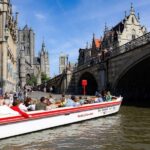
The tour starts at Hostel Uppelink, Sint-Michielsplein 21, 9000 Gent and finishes in the Patershol area. It’s offered in English, and the group max is 35 people, which usually helps keep the experience from feeling rushed.
Pacing matters on a walking tour, and this one is designed to be manageable. Reviews consistently mention a slow pace and that the walk is mostly level, so it’s easier to keep up even if you’re not a power-walker. Still, it’s nearly two hours on foot. If you have knee issues, plan for breaks and bring shoes with real grip—especially after dark.
Also, double-check your exact meeting details from your confirmation message. There have been cancellations and timing mix-ups reported in the wild, and the meeting point matters here.
Stop 1: St Michael’s Bridge and Ghent’s Three-Tower Skyline
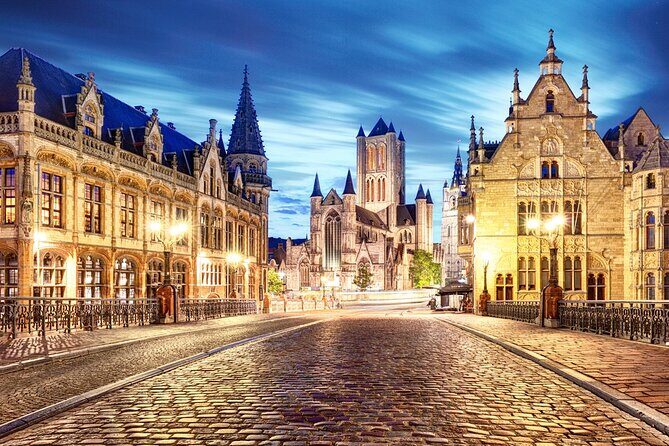
You start at St Michael’s Bridge, and that’s a smart move. From this spot, you get a clear sense of how Ghent’s medieval city center sits and why it mattered. The guide introduces the city’s medieval role as a trading hub, then shifts to the three towers of the Ghent skyline that are best visible from here.
Why this stop is valuable: it’s your orientation. If you’ve only seen Ghent in daylight, your brain will appreciate the “map moment” early on. You’ll better understand what you’re seeing as you move toward the harbor-area streets and bridges.
What to watch for: spend a minute looking across the skyline before you keep walking. The guide points out the towers, but you’ll get more out of it if you take a quick second to spot them yourself.
Stop 2: Graslei and Korenlei Quays, Where Trade Made Money
Next comes Graslei and Korenlei, the heart of the medieval harbor area. This is where Ghent flexed its economic power—back when trade wasn’t just commerce, it was survival, influence, and status.
You’ll hear about the city’s lucrative trading activities and how that wealth shaped the waterfront’s importance. This isn’t just “pretty canal views.” It’s how Ghent became a player in Europe, which helps when the tour later turns to conflict and religious rule.
A practical note: this section is usually where you’ll want to look upward at façades and down at the water. At night, the reflections can make the street feel wider and more dramatic. Just mind your footing near the edges of the quay.
Stop 3: Appelbrugparkje and Butchers’ Hall—Execution Legend Time
At Appelbrugparkje, the tour goes darker. You’ll get a legend tied to the execution of a father and son and a miraculous event that supposedly saved them. This stop also overlooks the Butchers’ Hall, which gives the story extra weight because you’re looking at a place connected to medieval guild life and public life.
Why it’s memorable: the tour’s tone shifts here from trade and city growth to punishment, cruelty, and hope-in-the-middle-of-terror. If you like stories that blend grim details with dramatic turns, this is one of the stops that tends to click.
If you’re sensitive to gruesome themes, mentally prepare here. This is exactly the part where the tour leans into the dark branding.





Stop 4: Castle of the Counts and How Viking Raids Shaped Ghent
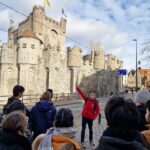
Then you reach the Castle of the Counts. This fortification was built by Count Baldwin in the 9th century to protect people from Viking raids—a concrete reason for why a defensive structure mattered. The guide explains how development started around the fort.
This is more than “medieval walls.” It’s a quick lesson in cause and effect. Raids forced defense. Defense attracted settlers. Settlers grew commerce and civic life. That chain helps you understand why Ghent keeps showing up as strategic territory later when conflict rises again in the tour.
A drawback for some people: you’ll get the story, but you might have to use your imagination to fully feel the scale, since fortifications and ruins don’t always look like the original “big picture” they once were.
Stop 4½: The Prince’s Court Imagination Moment
After the counts’ castle, the tour moves to what used to be a gigantic palace called the Prince’s Court. Today, you’ll need imagination, but the guide is there to supply it by bringing the palace’s story to life.
This stop is a good example of what you’re paying for with a walking tour: a human voice that helps you see what’s hard to picture from street level. Even if the remaining structures don’t shout their former size, the storytelling fills in the gaps.
Tip: if you’re the type who likes architecture, use this moment to notice how the streets and building lines suggest where power once concentrated.
Stop 5: Rabot Sluice and the Last Tower of the Defense Wall
Next is Rabot Sluice, where the guide shows you the only remaining tower of a much larger 14 km long defense wall built around Ghent in the Middle Ages. That’s a mind-bending scale: 14 km of defense, and only one tower left to prove it.
Why this works: it connects two things—fear and planning. Medieval cities didn’t just defend themselves by instinct. They engineered boundaries, water management, and barriers. Standing near what’s left, you can almost understand the logic of the system.
This is also a nice “pause stop,” since it gives you a tangible object to remember. The story comes attached to a physical landmark, which makes the facts stick.
Stop 6: Keizer Karel V and the Bridge of Imperial Delights
The tour heads toward Keizer Karel V and the Bridge of Imperial Delights, flanked by four sculptures depicting legendary scenes from the life of Charles V. The guide explains what some of those scenes are about and how Charles V’s story ties into Ghent’s wider political world.
If you enjoy symbolism—figures, carvings, and what people chose to memorialize—this stop is a strong one. Sculpture is often easier to remember than dates because your brain treats it like a visual clue.
Photo note: this is the kind of bridge where night lighting can make the sculptures stand out. Just don’t block others. Step to the side for your shot.
Stop 7: Religious Wars and Calvinist Rule
As you move along, the tour tackles the troublesome history of the Religious Wars and the effect of Calvinist rule on the city’s history. This is where the tour shifts from personal legends to power structures and ideology.
Why it matters: you’ll start to see how the “dark side” isn’t only about single gruesome events. It’s also about how authorities controlled belief, life, and punishment. The stories you heard earlier gain context: legends and executions didn’t happen in a vacuum.
A possible mismatch: a few people have said the darkness felt lighter than the title promised, because guides each choose how much to emphasize the gruesome side. If your goal is pure shock value, treat this as history with legends—not a horror show script.
Stop 8: Patershol, the Monk’s Quarter That Ends the Walk
The final stop brings you to Patershol, a picturesque medieval quarter often nicknamed Monk’s hole. The guide ends by explaining the social impact of the Industrial Revolution and the role it played in the revival of the city’s economy.
Ending here makes sense. You’re finishing with a neighborhood that’s easy to enjoy after dark, not a dead-end viewpoint. The tour ends in Patershol’s city-center area where you’ll find lots of cozy bars and restaurants, so you can turn the last ten minutes into your dinner walk.
This ending also gives the tour emotional balance. After stories of violence and power, you get the sense of how communities changed and adapted.
Price and Value: Why This Costs So Little
The price is $3.62 per person for about 1 hr 45 min. That’s the kind of rate that can only work if the goal is to keep it easy and accessible.
So what do you actually get for that low cost?
- A guided route through multiple medieval landmarks
- A story style that’s said to be funny and animated
- Stops you might not find on your own, especially the ones tied to legends and smaller monuments
- A night walk that turns Ghent’s center into something you can remember beyond one photo or one cathedral stop
Is it “premium theater”? No. But it’s a strong way to spend an evening if you want depth without spending a bundle.
What you should expect: you’ll cover ground on foot and you’ll spend time listening, not just sightseeing. That’s good value if you like narrative tours. If you’d rather wander silently, you might find it less satisfying.
Guides, Humor, and the Dark-Medieval Style
A big part of why this tour earns a 4.9 rating from hundreds of reviews is the guide performance. Names that come up often include Kenny, Isabel, Ben, and Julian. The common thread is lively storytelling, humor, and lots of small details about monuments and sculptures.
People also mention that the tour feels like walking with a local storyteller rather than marching with a strict timeline. If you enjoy asking questions and getting a witty response, this format usually feels easy.
One practical caution: because it’s a story-led tour, the exact balance of legends vs. darker material can vary by guide. That means the title promises dark medieval tales, but your experience might tilt more toward history and context with fewer truly gory moments, depending on the guide’s choices.
Who Should Book This Evening Dark Tour
This is a great fit if you:
- Want an evening plan that’s easy to commit to (about 1 hr 45 min)
- Like tours that mix history and legends
- Enjoy night walks and want a route that’s more than just the biggest landmarks
- Prefer a guided experience that includes jokes and energy, not silent museum-style narration
It might be less ideal if you:
- Are uncomfortable with graphic medieval themes (torture and execution stories are part of the tone)
- Want only light, family-friendly history with no grim content
- Need a strictly “scary” experience. Some parts lean more myth and political history than shock spectacle
Should You Book This Tour?
I think this is worth booking if you want your Ghent evening to feel like a story you’ll remember, not just a walk through pretty streets. The price is low enough that you can take the chance without regret, and the route hits real landmarks plus legend-linked stops that most independent walkers skip.
Book it if you’re okay with dark medieval themes and you like an energetic guide. If you’re sensitive to violence in stories, or you want a purely romantic night stroll, you might be happier with a lighter tour option instead.
FAQ
How long is the Evening Tour of the Dark Side of Gent?
It lasts about 1 hour 45 minutes.
What language is the tour offered in?
The tour is offered in English.
Where does the tour start and end?
It starts at Hostel Uppelink, Sint-Michielsplein 21, 9000 Gent, Belgium, and ends in the Patershol area in Ghent.
Is the ticket mobile?
Yes, the tour uses a mobile ticket.
How much does it cost?
The price is $3.62 per person.
What if the weather is bad or I need to cancel?
If the tour is canceled due to poor weather, you’ll be offered a different date or a full refund. You can cancel for a full refund up to 24 hours in advance.